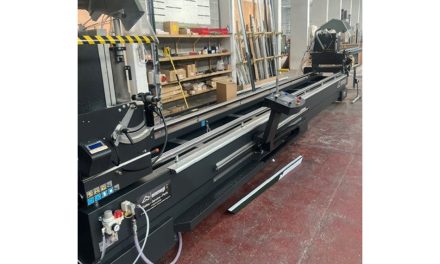
Kombimatec’s PBM60 brings greater control to a process that has traditionally depended on operator skill. For window fabricators, the commercial case is less waste, more consistent curved frames and a practical, and affordable, route into a specialist part of the market.
Curved frames can make a window stand out, and the ability to offer them as part of your overall product range can help enhance your offering. But producing them has long required a lot from the factory floor. Traditionally, bending methods require the PVC-U profile to be heated until it becomes pliable, transferred to a former and shaped by hand. The timing and handling matter. Too much heat, or a poor transfer, can leave a profile creased, collapsed or simply the wrong shape. Rejected material means lost time as well as lost stock.
Kombimatec’s PBM60 is designed to make the bending stage more controlled. It is a hydraulic, three-roll system that takes a length of profile through a series of passes. A computer-controlled process positions the steel rollers to achieve the required radius, while low-temperature heaters bring the profile to around 40°C to make it workable. Rather than being heated to a high temperature and quickly wrapped around a former, the extrusion is shaped progressively.

David Parsons
That change reduces the amount of judgement required during each bend. The operator still needs to support the profile internally and externally before it enters the machine, and the process still calls for correct preparation and setup. The PBM60 does not remove the need for skill or care. It does, however, automate the movement that creates the radius, helping operators produce a smoother, more consistent result without relying solely on years of manual experience.
Kombimatec’s managing director David Parsons commented: “The process is not simply about obtaining a curve that looks right at the machine. A predictable radius gives production teams a more reliable starting point for building the finished frame and planning repeat orders. That helps bring curved work into the same conversations about throughput and quality control as more familiar straight products”.
For fabricators already making arched frames, consistency can have a direct effect on costs. Profiles are an increasingly valuable part of the bill of materials, so material that can be used rather than scrapped protects the job margin. Repeatable bending also makes it easier to plan production and reduces the disruption caused by having to remake a frame. Where several matching shapes are required, getting the radius right each time is as important as achieving it once.
The machine may also make curved work more accessible to businesses that have previously outsourced it or avoided it because of the skills and handling involved.
“Arched windows can help fabricators respond to heritage, commercial and higher-end residential projects, as well as specialist conservatory designs” added David Parsons. “The opportunity will depend on the work a business can secure, but adding the capability can give it another way to compete when customers need something beyond a standard rectangular frame”.
Kombimatec offers the PBM60 as a standalone machine, or as part of an optional package with an EKS432 single-head welder and AFV370 electronic radius end miller. For a fabricator building a curved-window capability, a matched package can simplify the task of planning the equipment needed around the bend itself.
Before investing, fabricators will need to look at their likely order volume, current costs of outsourcing or rejects, operator availability and the downstream processes needed to finish the frame. Automation does not create demand on its own. But where curved work fits the company’s customer base, more predictable production and better use of profile can turn a difficult specialist process into a more manageable part of the business.
Return To Newsletter